Premium composite decking is the top band of the WPC range: a board capped on all four faces with ASA, a core that carries the load, and third-party test reports behind every number quoted below. We extrude it on our own lines in Foshan, Guangdong, and we publish the measurements because most of what is sold as premium is sold on adjectives. Where a test result answers a problem buyers actually have — fading, swelling, frost damage, boards working loose at the fixings — the number appears with the standard it was measured against, so you can check the method instead of trusting the claim.
What separates a premium board from an ordinary capped board
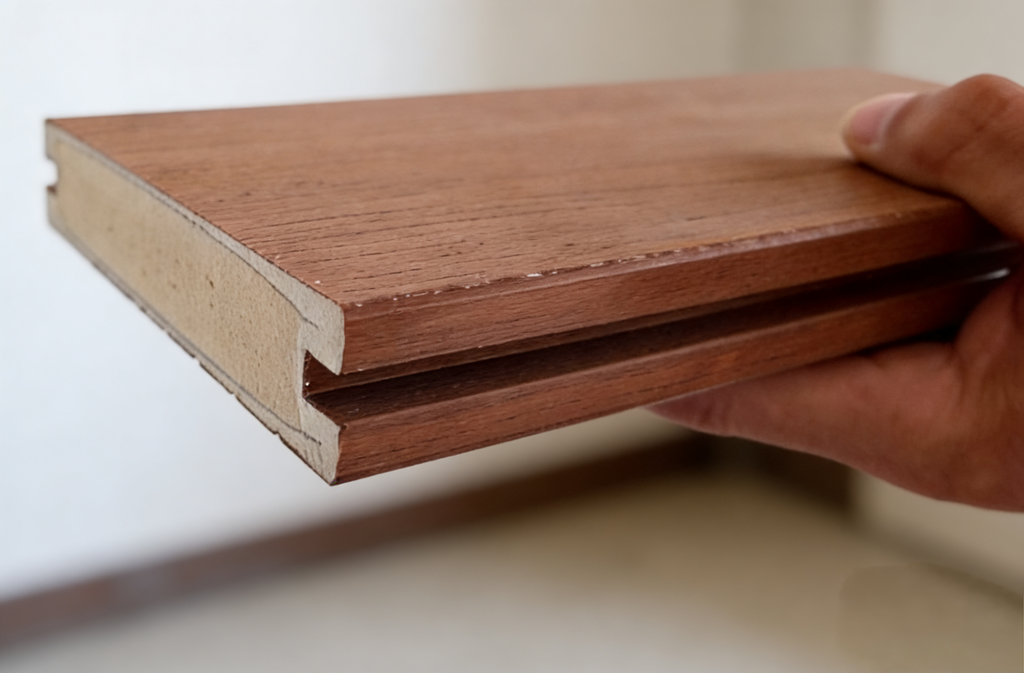
Almost every outdoor board sold today calls itself capped. The word covers boards with a thin film on the top face and boards wrapped on all four sides in a different polymer entirely. Five questions separate them, and a supplier who can answer all five in writing is usually selling the second kind.
| What to ask | What a premium answer looks like |
| Is the cap on all four faces? | Four-sided cap; an exposed core edge is where moisture starts |
| What is the cap made of? | ASA or an equivalent UV-stable polymer, not a thin PE film |
| Does the colour run through the cap? | Pigment in the cap layer, not a printed or coated surface |
| How much does the board move? | A stated thermal expansion figure, and a system that allows it |
| What testing exists? | A third-party report with a standard number, not a claim |
Specifications: four profiles, one system
All four profiles share the same cap and the same clip system, so you can mix widths on one job without changing the substructure. Area per board is nominal board face — length × width — and the clip gap between boards reduces the installed figure slightly, which is worth allowing for before you price a deck.
| Picture | Profile | Board size | Length | Weight |
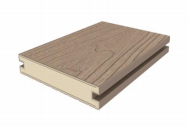 | Standard-Solid | 140 × 25 mm | 2.9 m, or to order | 3.1kg/m |
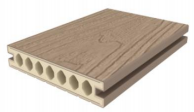 | Standard-Hollow | 140 × 25mm | 2.9 m, or to order | 2.8kg/m |
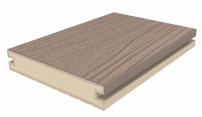 | Standard-Solid | 140 × 23mm | 2.9 m, or to order | 2.9kg/m |
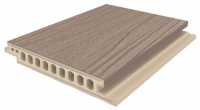 | Tight butt-Hollow | 160 × 20mm | 2.9 m, or to order | 2.3kg/m |
Regular composite decking usually requires 300-400 mm joist spacing, while this premium composite decking series can exceed 500 mm thanks to its higher strength, helping projects cut costs and lower overall budgets. And extra -long specifications and sizes are available upon customization.
Why a thick 360° ASA cap is what you are actually paying for
ASA — acrylonitrile styrene acrylate — is used where colour has to survive UV, which is why it turns up on automotive trim and outdoor cladding rather than on indoor furniture. On a deck it does one job: it holds the pigment in the outer layer instead of letting the sun work through it. Unlike other products that have an ASA cap of only 0.03 -0.04 mm, it is 0.08-0.10 mm. This makes its superior weather resistance self-evident and positions this premium composite decking series a standout performer on the market.
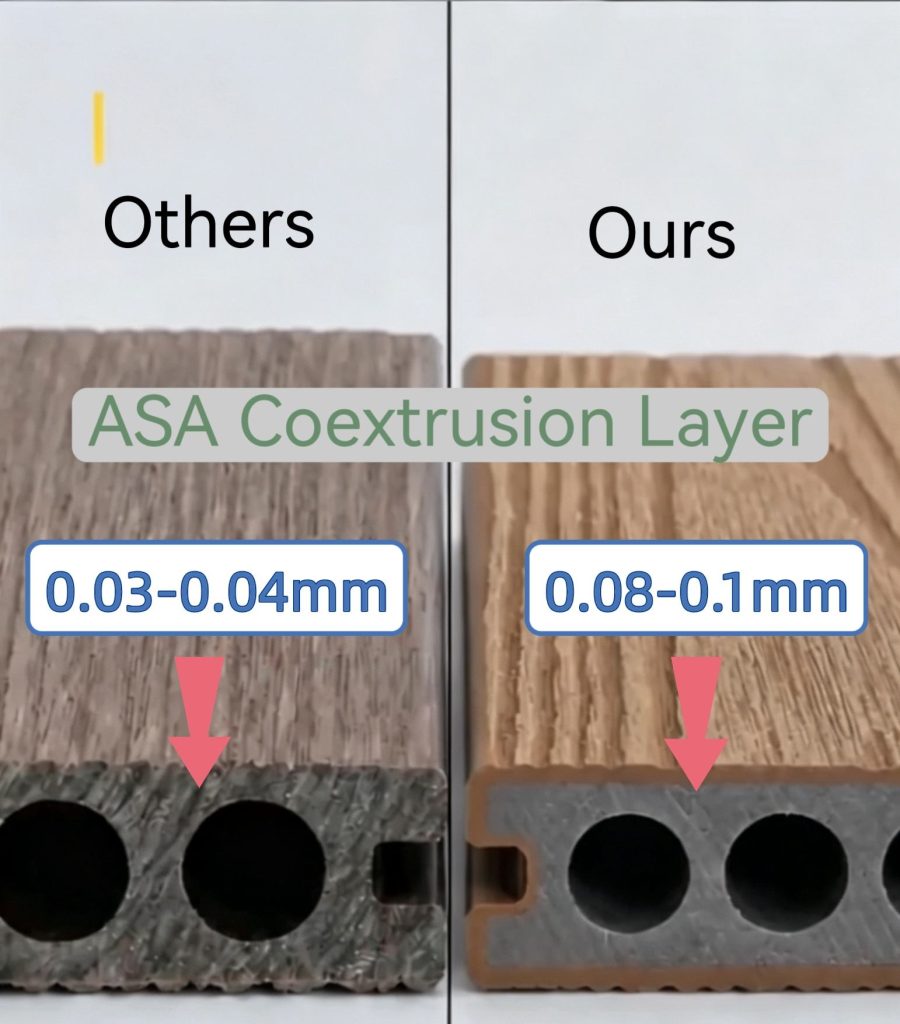
- Colour retention. The pigment sits in the capped layer, so a fade in year eight is a fade of the cap, not a repaint of the whole board. Designing surface layers to remain stable under prolonged high-UV radiation.
- Stain and scratch resistance. The surface closes the wood fibre off, so oil, wine and grill grease sit on top and wipe off.
- Low thermal expansion. The board moves less than an uncapped PE composite, which is what lets long runs work without an oversized gap.
- Wood grain that is extruded, not printed. The texture comes out of the die, so brushing it back does not reveal a smooth surface underneath.
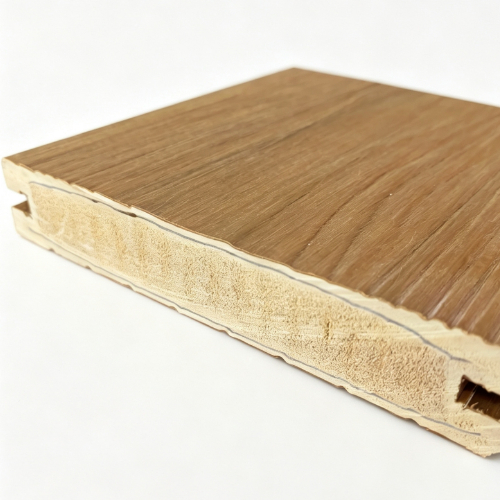
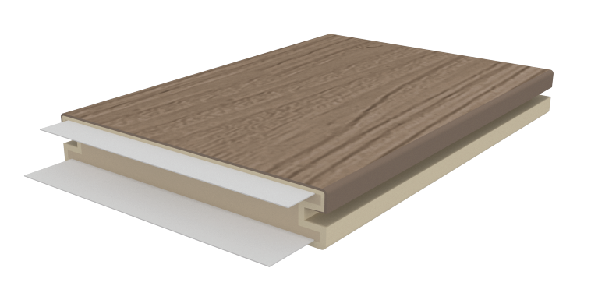
Under the cap sits a reinforced PVC core. It is the part that carries the load and the part that keeps the board from absorbing water — the cap protects the colour, the core protects the section. With the cap intact, the service life we quote is 30+ years, and that figure assumes a ventilated substructure.
What actually fails outdoors, and the number we measured for each
Composite decking fails in a short list of predictable ways, and each one has a test that puts a figure on it. The table below is that list: what goes wrong, the test we ran against it, the standard the test follows, and the result from the report. No row is a promise — every row is a measurement you can ask to see.
| What goes wrong | Test we ran | Standard | Measured |
| Boards take on water and swell at the cut edge | Water absorption and thickness swell, 24 h immersion at 23 °C | ASTM D7031-11(2019) §5.19 / ASTM D1037-12 §23 Method B | 1.12 % absorption, 0.70 % swell |
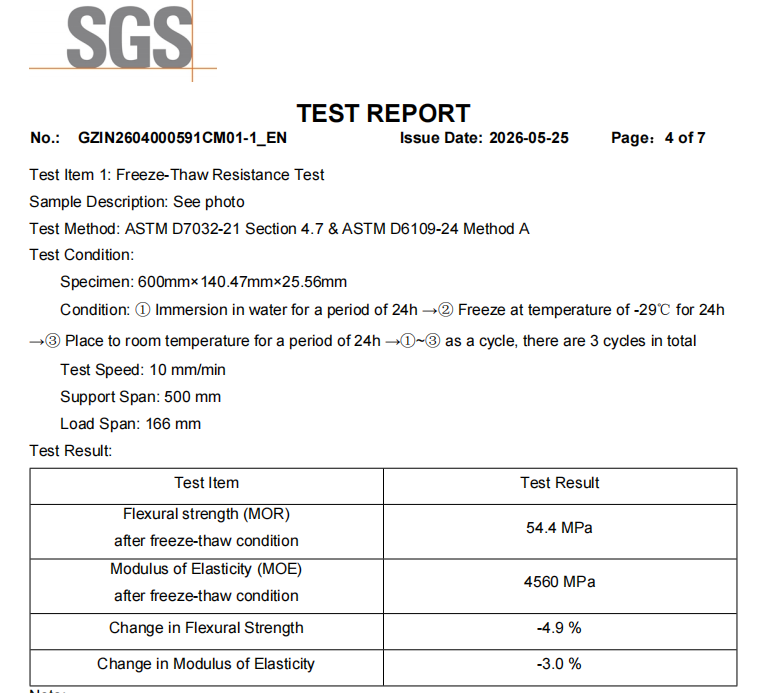
| A northern winter cracks the section | Three freeze-thaw cycles (−29 °C), then flexural testing | ASTM D7032-21 §4.7 / ASTM D6109-24 Method A | MOR 54.4 MPa, MOE 4,560 MPa; −4.9 % and −3.0 % against control |
| Boards lift at the fixings under wind load and foot traffic | Fastener holding | ASTM D7032-21 §5.5 / ASTM D1761-20(2025) | 2,380 N |
| Long runs buckle when summer heat arrives | Coefficient of linear thermal expansion | ASTM D696-24 | 3.195 × 10⁻⁵ /°C |
| Wet decking becomes a liability at the pool edge | Slip resistance, dry and wet, parallel and perpendicular to grain | ASTM D7032-21 §5.6 / ASTM D2394-17(2022) §33–37 | Static 0.74–0.89, kinetic 0.72–0.90 — every reading above 0.6 |
| Furniture, grit and heels grind the surface away | Abrasion, CS-17 wheel, 1,000 g load, 1,000 cycles | ASTM D7031-11(2019) §5.17 / ASTM D4060-25 | 110.6 mg loss |
| Dropped tools, hail, a shifting planter | Impact, 4.54 kg dart | ASTM D7031-11(2019) §5.12 / ASTM D4495-21 | 67 J mean failure energy |
| Planters and heavy furniture leave a dent that stays | Creep-recovery | ASTM D7032-21 §5.4 | 90 % recovery after load removal |
Two rows need translating. Water absorption of 1.12 % is the reason a cut end does not swell open after a wet winter, and 0.70 % thickness swell is the number to compare against the uncapped boards that visibly cup at the board edge. On slip, specifiers commonly set 0.6 as the floor for a wet walking surface; the lowest wet reading on this board is 0.74 static and 0.76 kinetic, taken parallel to the grain — the direction a foot actually slides.
| Board length | Movement over a 40 °C swing |
| 2.9 m | 3.7 mm |
| 3.6 m | 4.6 mm |
| 4.0 m | 5.1 mm |
| 5.8 m | 7.4 mm |
That table is the thermal expansion coefficient turned into millimetres at your board length. It is the reason a 5.8 m run needs an expansion gap at each end rather than a hard-fixed butt joint — and the reason an installer who brings a PVC habit to a WPC deck is the most common cause of a board lifting in its second summer.
The step-by-step sequence matters here more than on a timber deck: the gap has to be designed at set-out, not discovered on the last board. The full run — joist spacing, where the gap goes, how the trim covers it — is set out stage by stage in the installation guide.
Colour: the number we publish, and the number we do not
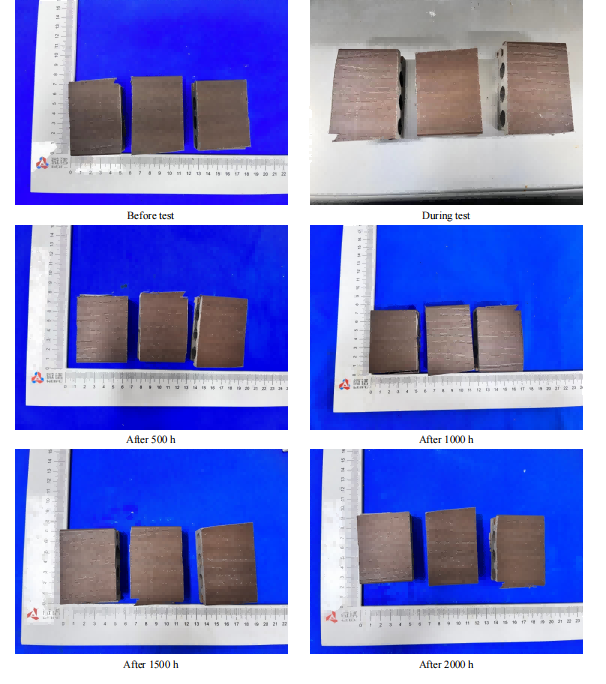
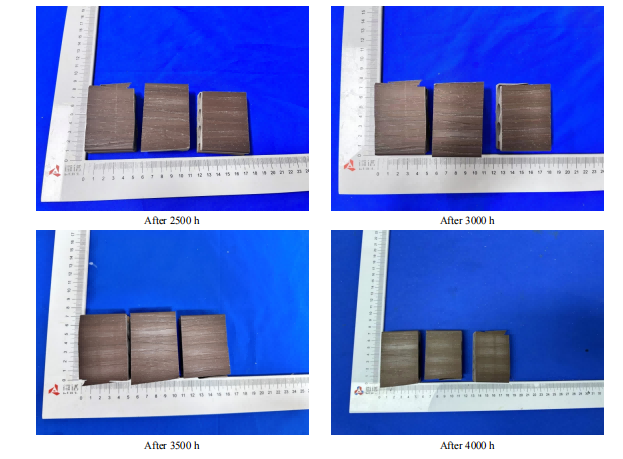
Accelerated weathering is where most suppliers quote a single figure and stop. Ours changes at 4,000 hours, so it is worth showing you exactly where it changes and where we stop claiming.
| Accelerated weathering | Mean ΔE* | What it means |
| 1,500 h | 0.64 | Not visible |
| 2,000 h | 0.64 | Not visible |
| 2,500 h | 0.70 | Not visible |
| 3,000 h | 0.96 | Still under 1 — not visible on a textured surface |
| 3,500 h | 1.87 | Visible on close inspection |
| 4,000 h | 4.58 | Visible at arm’s length; lightness L* rises 33.0 → 37.7 |
So we claim colour fastness to 3,000 hours, average ΔE* 0.96, and we do not claim the board is unchanged at 4,000. If you are comparing suppliers on hours, ask which colour and which ΔE — the same board passes or fails depending on the tone, and a number without a tone behind it is a number without a test behind it.
Scope, stated plainly: weathering, freeze-thaw, impact, slip, abrasion and moisture data were produced on the hollow profile at 140 × 25 mm; the compliance reports below were issued on the solid profile BY-N113Y16. Reports for any production profile we quote are available on request.
Eight colours, one grain family
All eight tones come off the same cap and the same extrusion die, so the brushed grain runs identically across the range — the only variable between them is pigment. That matters more than it sounds: a board whose grain is printed will show a different texture in every colour, and a replacement board ordered two seasons later will not match the first. See standard ASA capped line
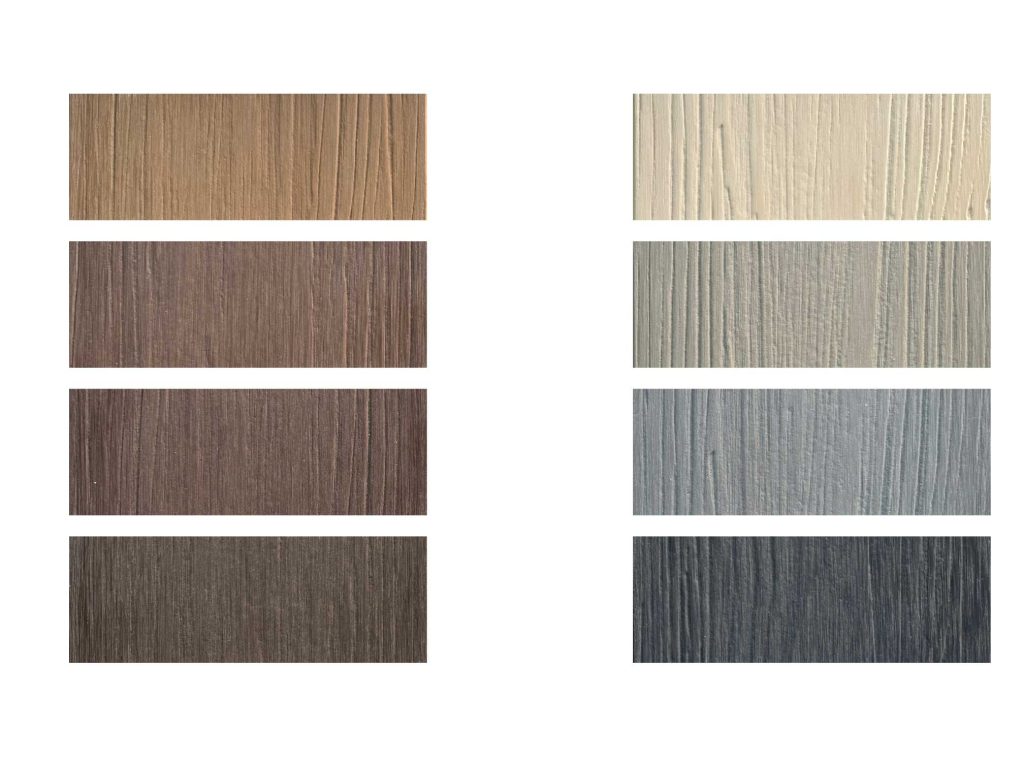
| Colour | Tone | Grain | Where it works |
| Golden Teak | Warm mid-brown, the lightest of the browns | Brushed linear | Decks that sit in full sun; the tone that reads closest to timber |
| Rosewood | Red-brown, high saturation | Brushed linear | Traditional and craftsman houses; warm-toned render |
| Walnut Brown | Deep chocolate brown | Brushed linear | Most forgiving on dirt and leaf tannin |
| Coffee Brown | Dark brown with a grey cast | Brushed linear | Contemporary facades, dark window frames |
| Sandstone | Cream to ivory | Brushed linear | Pool surrounds — reads cool underfoot and hides salt bloom |
| Silver Grey | Light cool grey | Brushed linear | Coastal and modern builds; the fastest-moving tone in the grey family |
| Slate Grey | Mid grey with a blue cast | Brushed linear | Rooftop terraces, commercial walkways |
| Charcoal | Near-black graphite | Brushed linear | High-contrast framing against light cladding |
Colour performance is where the range is not uniform, and it is worth being straight about it. Our accelerated weathering data — mean ΔE* 0.96 at 3,000 hours — was produced on a brown/beige tone. Lightness drift is what shows first on a dark board, so if you are specifying Charcoal or Slate Grey for a high-UV project, ask us for the weathering report on that tone before you commit. We would rather send you an extra PDF than have a deck argued about in year six.
Screens lie about colour. Every tone is despatched as a physical sample before an order — tell us which two or three you are choosing between and we send those, not the whole fan.
The reports behind these numbers
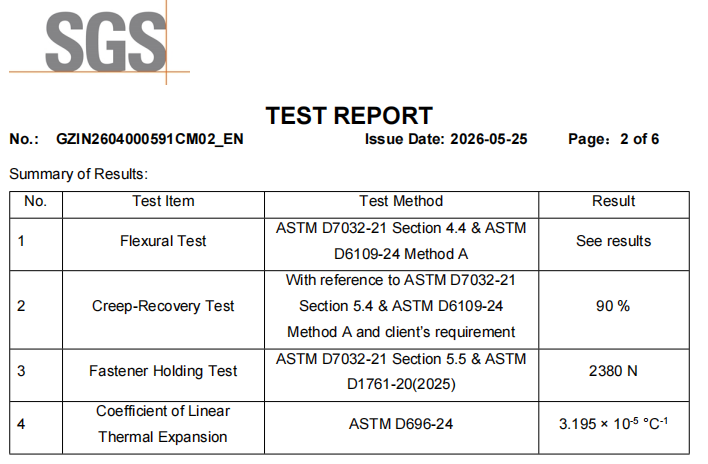
Five reports sit behind this page, all issued in 2026 by SGS. Each carries a report number that can be checked against SGS’s own records, and the full PDFs go out with any quote or sample.
| Report number | Issued | What it covers | Pages |
| GZIN2604000591CM01-1 | 25 May 2026 | Freeze-thaw, impact, slip resistance, abrasion, water absorption, accelerated weathering | 7 |
| GZIN2604000591CM02 | 25 May 2026 | Flexural, creep-recovery, fastener holding, thermal expansion | 6 |
| SHAIN26007224811 | 23 Apr 2026 | Formaldehyde emission — ASTM D6007-22, 1 m³ chamber, CARB ATCM Phase 1 / TSCA Title VI | 4 |
| SHAIN26007224807 | 23 Apr 2026 | EU RoHS 2015/863 — Pb, Hg, Cd, Cr(VI), PBB, PBDE, DEHP, BBP, DBP, DIBP | 8 |
| SHAIN26007224809 | 23 Apr 2026 | REACH SVHC screening — 253 substances | 15 |
For importers: the three files your customer will ask for
| Substance / regulation | Substance / regulation Requirement | Result |
| Formaldehyde emission (CARB ATCM Phase 1 / TSCA Title VI) | Limit 0.08 ppm | Not detected — below the 0.01 ppm detection limit |
| EU RoHS 2015/863 — ten restricted substances | 100–1,000 mg/kg per substance | Not detected — all ten, detection limit 2–5 mg/kg |
| REACH SVHC candidate list — 253 substances | None above 0.1 % w/w | Pass — none above 0.1 % w/w |
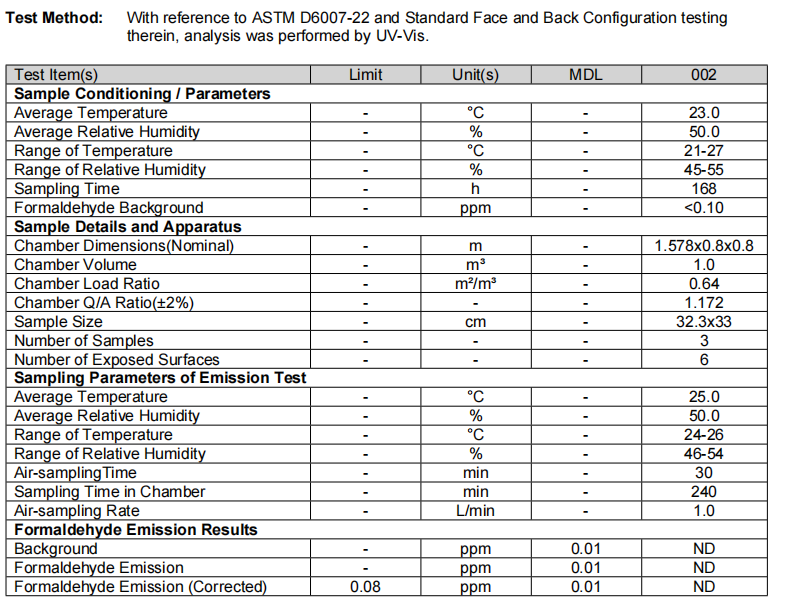
A missing file is a container sitting at a port, or a retailer refusing to onboard a product line. All three are available as PDFs the same day, and the specimen declaration — solid profile, board code BY-N113Y16 — matches the compliance reports above so your importer is not reconciling two different sample descriptions. Request the test pack and it comes back with the report numbers, not a summary: ask for the test pack.
Colours, samples and what a screen cannot tell you
The range is matched to your project from our current colour line, and every enquiry gets a physical sample before an order — colour on a screen is not a colour, and every dispute I have seen in fifteen years started with a screen. Send the tone you are working to and we will send the board to hold against the deck it has to match.
Buying premium composite decking direct from the manufacturer
We are a WPC manufacturer, not a distributor — 47 extrusion lines, 5M+ m² a year, 30+ export markets, and fifteen years on the production side. That changes three things for a buyer: the price is FOB rather than landed, the spec is adjustable before the die runs, and the answer to a technical question comes from the line.
- Minimum order: 300 m² per board profile.
- Lead time: 25–30 days production before freight.
- Samples: A physical sample goes out before any order — send the tone you need to match.
- Mixed containers: Ask before you book — profiles and colours can usually be combined within one container.
Full terms, packing details and FOB pricing are on the trade terms page; if you would rather just send a drawing and a quantity, use the quote form and you will have a price within one business day.
What the board costs, and what a deck costs
A premium board runs $35–$42 per board depending on profile and finish, which works out to roughly $7.0–$9.30 per square foot — the spread is almost entirely board length, not quality. For the per-board arithmetic see the cost per square foot breakdown; for installed cost, substructure and what a whole deck comes to, start with composite decking cost.
FAQ
Is premium composite decking worth the extra over a standard capped board?
It depends on UV load more than on taste. In a high-sun climate the difference shows up as colour retention at year five to eight; in a shaded northern installation, a standard capped board and a premium one can look the same at year ten. Pay for the cap where the sun hits hard.
How long does an ASA-capped board last?
We quote 30+ years for the board, with a ventilated substructure and correct joist spacing. The figure is a board-life figure — the substructure and the fixings are what actually end a deck’s life, and no cap changes that.
Can I order a small quantity to test?
Yes — for a first order we can work below the 300 m² minimum, and you can mix up to three colours or profiles in the same shipment to make up the quantity. Samples are free of charge; you cover the courier cost, and we credit it back against your order once it is placed.
Can you prove the numbers on this page?
Every figure is from a report with a number printed on it — the five reports are listed above, the PDFs go out with any quote, and the report numbers can be checked with SGS directly. Where a result is not in our favour, such as the colour shift between 3,000 and 4,000 hours, it is on the page too.
Which colour holds its colour best?
The browns and Sandstone hold a visual match longest, because the change we measure is a rise in lightness and a light board has further to travel before the eye notices. Charcoal shows drift earliest. For a high-UV site in a dark tone, ask for the weathering data on that specific colour.
Send the quantity, the profile and the destination port, and you get FOB, lead time and packing back within one business day.